
Kimble Docket History Has Gaps
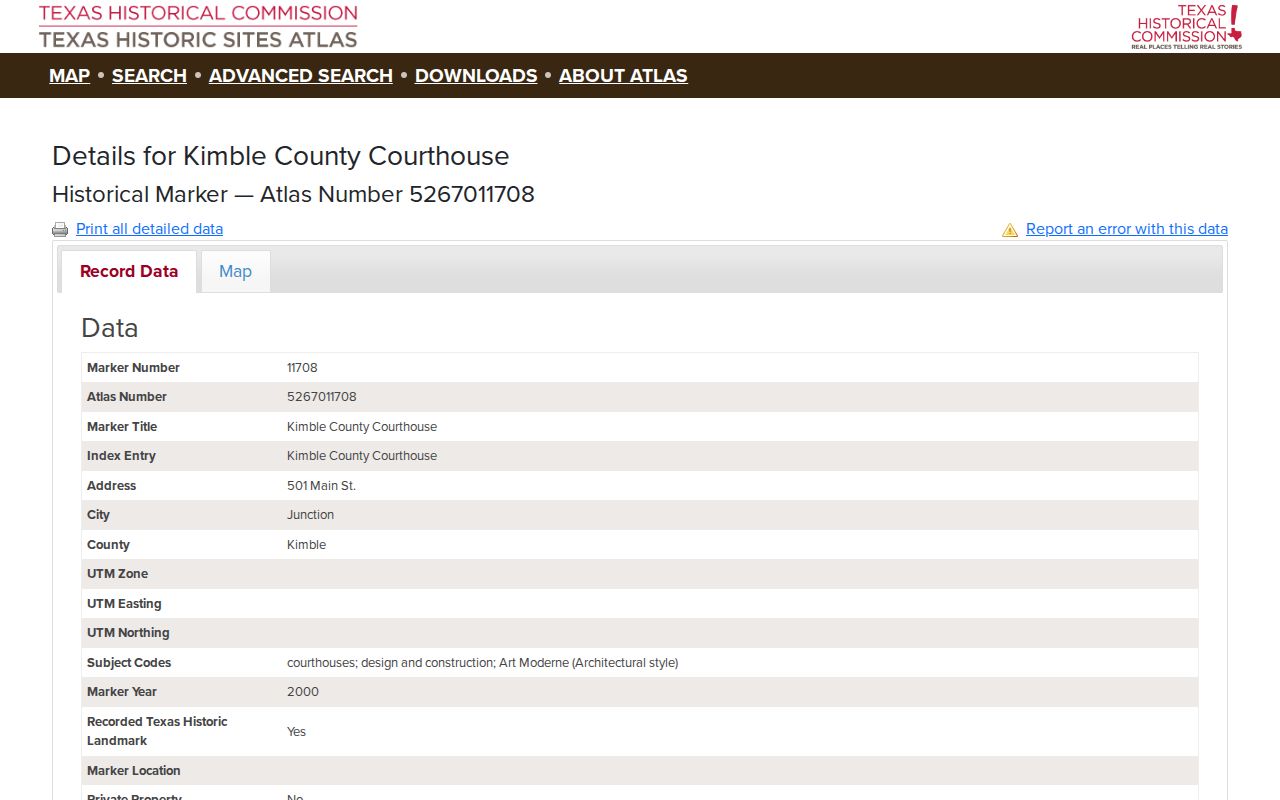
Kimble County's legal past has holes, and they shape any docket search today. The Texas Historical Commission notes the first district court here met under a live oak. That was in 1877. Then came a hard loss. The county's frame courthouse burned on April 22, 1884. Every county record in it was destroyed. A later building gave way to the present Art Moderne courthouse in 1929. It earned Recorded Texas Historic Landmark status in 2000. An old case may sit in a paper archive. It may survive only in an index, or be gone for good.
Restoration adds another wrinkle. The courthouse project protects a public landmark. Clerks and hearings now run from other Junction sites. For historical docket work, ask one thing first. What date range exists in paper, index, or digital form? Assume nothing until you know. The Texas Historic Sites Atlas documents the courthouse and its record history.
How to Search the Kimble County Court Docket
Match the court before you type a name. The District Clerk links re:SearchTX and Tyler UCMS for district matters. County criminal, probate, guardianship, and constitutional County Court files route through the County Clerk. A DPS or county ticket belongs with the Justice of the Peace. A Junction citation is a Municipal Court matter. Texas offers no single index covering every trial court.
Gather the court, case or cause number, party style, and a likely filing or hearing date, then run a docket search with just enough detail to single out the right case. A blank result proves nothing. Old files may still need a clerk request. So may cases outside a participating system and restricted matters.
- Identify whether the matter is district, county, justice, municipal, or federal.
- Open the matching official clerk page or court portal.
- Try the case number first, then a carefully formatted party name.
- Compare the court, county, filing date, status, and next setting.
- Confirm the result and any certified copy with the record custodian.
Kimble County Uses Three Search Systems
The clerk pages bundle several systems. Each does a different job. re:SearchTX can supply case, party, filing, document, and hearing detail when a participating court feeds it. Tyler UCMS splits its lookups into cases, judgments, and warrants. Smart Search takes a record number or a last-name-first query with filters for location, case type, status, file date, and judicial officer.
The county-linked iDocket page leans toward property indexes and recorded documents, so treat it as a tool, not the court docket itself. eFileTexas receives required electronic filings, but it is not a public docket viewer. Turn to UCMS or re:SearchTX for a case lookup, the 452nd portal for its child-protection calendar, and the clerk for an official file.
What a Court Docket Shows
Think of a Kimble County court docket as the case's activity log. Entries may carry the cause number, style, court, case type, and filing date. They may also list parties, attorneys, judicial officer, status, filings, orders, hearings, judgments, and disposition. A calendar line can add the hearing time, location, appearance mode, and future date. Remember what it is not. The docket indexes activity. It does not always hold the full text of every document.
| Case Number | The court's identifier; copy it exactly rather than guessing a format. |
|---|---|
| Parties | The public case style, subject to confidentiality and redaction rules. |
| Docket Entries / Filings | A dated list of pleadings, orders, notices, and other activity. |
| Hearing Settings | Date, time, hearing type, and sometimes the appearance method. |
| Court & Judge | The court and judicial officer tied to that entry. |
| Disposition | The recorded outcome, which differs from a pending setting. |
The 452nd Docket Crosses Five Counties
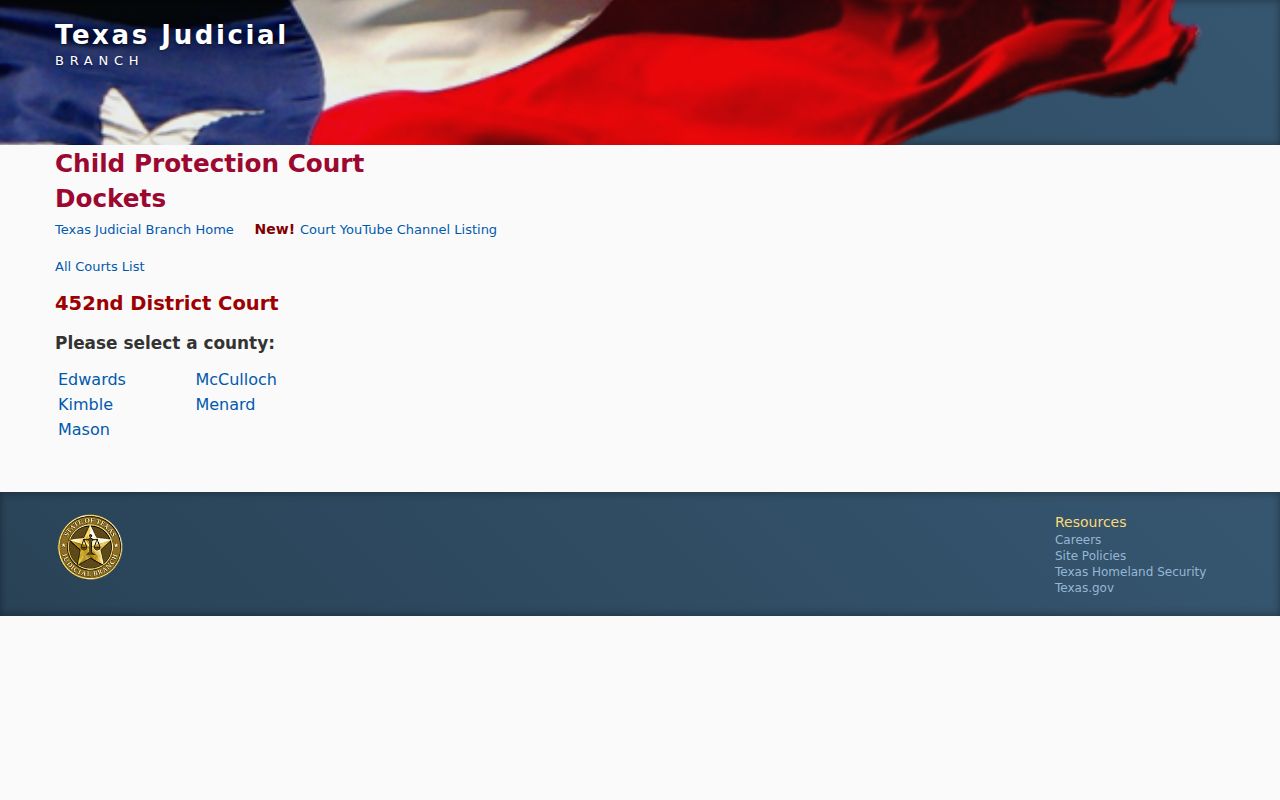
The 452nd Judicial District Court covers Edwards, Kimble, Mason, McCulloch, and Menard counties. So a court number alone won't isolate your case. On the child-protection posting system, pick the 452nd court first, then Kimble County. That second step separates a Kimble setting from other cases on the regional docket.
One more caution applies before you drive anywhere. The court coordinator's administrative contact sits in Mason. That mailing address is not the Kimble courtroom. Check the posted county, date, and venue first. The official posting system displays Kimble in the 452nd district list.
Which Courts Keep Dockets
Kimble County splits its docket duties across several courts. The 452nd District Court hears felonies. District civil and family cases sit there too. County-level criminal and civil work stays with the constitutional County Court. Probate within its authority stays there too. The Justice of the Peace takes county and DPS traffic cases, small claims, and evictions. Junction Municipal Court handles municipal ordinance and fine-only criminal matters inside city limits.
| Court | Docket Covers | Where to Search |
|---|---|---|
| 452nd District Court | Felony, district civil, and family | District Clerk, UCMS, re:SearchTX |
| Constitutional County Court | County criminal, civil, and probate jurisdiction | County Clerk |
| Justice and Municipal Courts | JP civil and traffic; Junction city cases | The responsible local court |
District Clerk or County Clerk?
Kimble's public pages list Karen E. Page for both clerk functions. The state directory calls it a combo office. The record paths still split. District Clerk requests cover 452nd District Court criminal, civil, and family files. County Clerk requests cover constitutional County Court cases, probate, guardianship, and county civil records. One contact block never merges the courts or their dockets.
The Justice of the Peace keeps its own traffic and civil matters. Junction Municipal Court stands apart as well. Name the court in your request. That way a shared office does not have to guess which record series you mean.
Finding Court Dates and Settings
UCMS Hearing Search filters by location, department, judicial officer, date range, case number, party name, and hearing type. The 452nd child-protection system walks through a court, county, and date choice. Only then does it show a posted docket. Both are case-hearing sources. The county Public Notices calendar mostly lists meetings, holidays, and elections. Do not treat it as a case calendar.
A setting can shift through a reset, continuance, cancellation, or later order. Check the Kimble County court calendar. Then confirm time and place with the clerk or coordinator. And one rule stands: watching a remote hearing does not authorize recording it.
Kimble Courtrooms During Restoration
Kimble County's courthouse restoration moved several offices. A county annex notice lists the County and District Clerk at 105 Reid Road, the County Judge at 105 N 7th Street, and the Justice of the Peace at 415 Main Street. Courtrooms may sit in unexpected spots. The notice names local churches, the Stevenson Community Center, the County Judge's office, and the JP office as possible hearing sites.
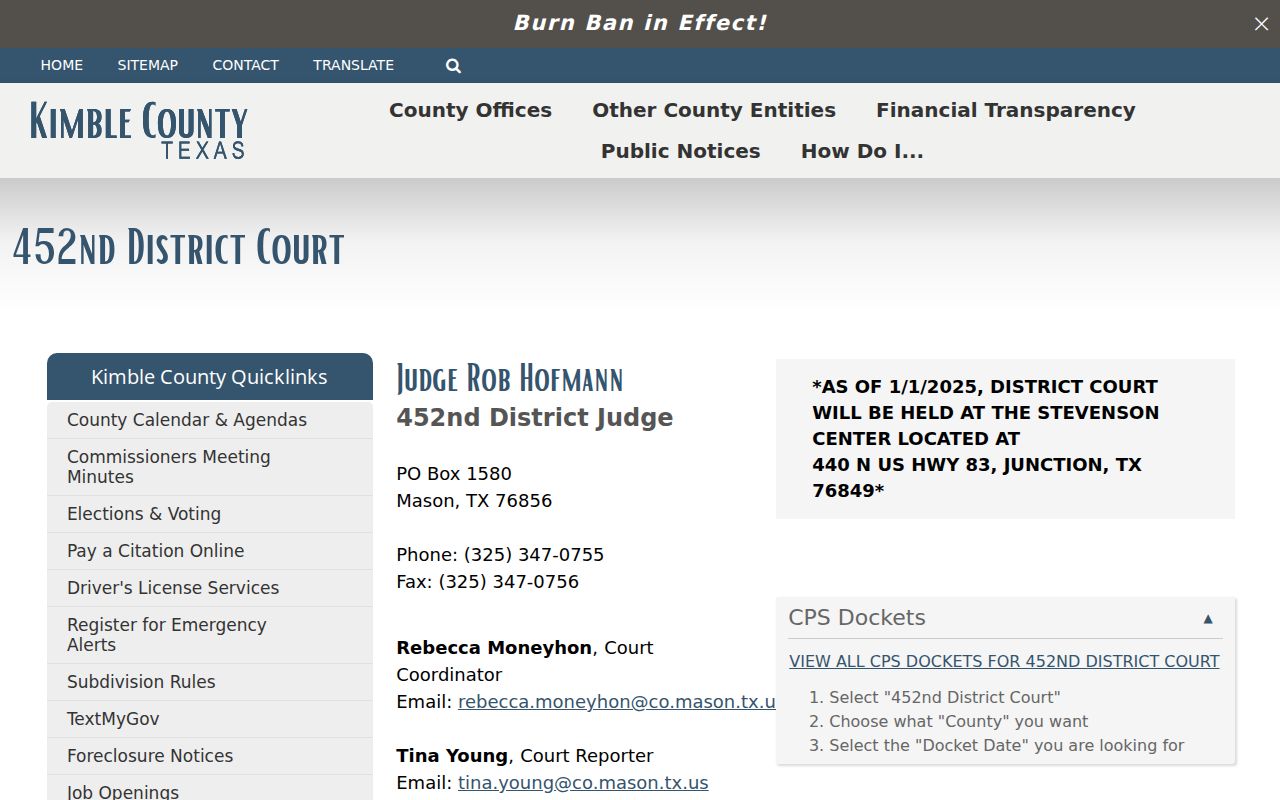
For district court, the answer is firmer. Kimble district court sessions move to the Stevenson Center, 440 N US Highway 83, starting January 1, 2025. County Court works differently. Its page lets the judge designate a location later. Guessing is a mistake. The historic courthouse, the clerk counter, and the coordinator's mailing address all sit apart from where your hearing may actually land, so check before any court date. The official District Court page supplies the venue instruction.
Public Access to Dockets
Court records in Texas do not travel the usual agency route. A docket or case file is an adjudicative record, made while deciding a case, so court rules and clerk procedures govern it rather than a routine Texas Public Information Act request. Rule of Judicial Administration 12 generally opens covered judicial records during regular business hours, though exclusions apply. Rule of Civil Procedure 76a covers sealed civil records.
Expect limits. Family Code chapter 58 can restrict juvenile files. The 452nd standing order shields covered DFPS child-protection documents. Rule 21c demands redaction of sensitive data. So a Kimble County docket search may return some entries while sealed filings, protected personal data, and certain warrant detail stay offline even when the rest of the record is public.
Key Rules:
Texas Rule of Judicial Administration 12 governs access to covered judicial records.
Texas Family Code chapter 58 restricts juvenile justice information.
Texas Rules 21c and 76a address sensitive data and sealed civil records.
When a Kimble Search Finds Nothing
A Kimble County docket search that comes up empty is rarely a dead end. Check spelling first. Then check name order, court, county, and date range. In UCMS, keep Cases, Judgments, and Warrants straight as separate searches. On a regional docket, confirm Kimble County is actually selected. A blank result can simply mean the case is too new, too old, stored elsewhere, entered under another party format, confidential, or filed in a different court.
When careful variations still fail, call the right office. Give the court, the case number if you have it, the party style, the event range, and the document you want. Skip needless private identifiers. Ask about a plain copy, a certified copy, in-person inspection, and a fee estimate. Only the court or clerk can confirm whether a matter exists or is restricted.
The Clerk and Docket Records
When an online docket falls short, the Kimble County clerk office is the reliable offline route. It serves court records or official copies. A good request names the court, the cause number, the party style, the filing date or range, the record type, and whether you need certification. Local fee sheets put copies at $1 per page and certification at $5 per document. Those figures carry source dates, so confirm the total before paying.
Filing works differently for new cases. Covered district and county filings must go through eFileTexas under local instructions. Electronic filing does not make every old case document downloadable. The clerk can walk you through inspection, email, mail, pickup, and certification options. Ask for what you need.
Kimble County District and County Clerk
105 Reid Road
Junction, TX 76849
(325) 446-3353
Kimble Fees Have Source Dates
Treat Kimble County fee numbers as dated snapshots, not fixed prices. The linked district and county fee sheets label their figures as effective in 2025. One county PDF sits in a later folder. The district sheet charges $350 for a new civil or family suit. It adds $80 for a district civil subsequent filing. The county sheet lists $350 for an occupational driver's license suit and $360 for probate or guardianship. Service, citations, and other charges may ride along on top.
Use those figures to frame a question. Ask which fee sheet applies and whether later orders changed the total. And remember that a portal printout is not a certified copy from the clerk.
Court Dockets by City in Kimble County
Junction is the only incorporated city with an official city page in this county. Geography and court sources back that status. Its Municipal Court handles city ordinance and fine-only criminal matters inside city limits. The court posts no stable public docket feed. So a Junction docket search starts with a call to the court itself. London, Roosevelt, Telegraph, and other rural communities have no municipal status or separate municipal court. They get no city pages.
That one-city shape makes jurisdiction unusually clear. A Junction resident might still hold a DPS ticket in Justice Court. A probate matter might sit with the County Clerk. A felony could be in the 452nd District Court. Read the issuing agency and court name before choosing a docket search path. For a municipal request, bring the citation number, issue date, violation type, and record sought. For a county case, use the cause number and the correct clerk.
Building pages for unincorporated places would imply municipal dockets that no official source shows. So Junction keeps the city page. The countywide pages serve every other community without inventing a local court.
The county counts 4,286 residents per the 2020 Census. A July 2025 estimate puts it at 4,438. Those numbers describe Kimble County, not the Junction Municipal Court caseload. They do help explain why access runs through a compact set of offices plus statewide systems. Population data cannot tell you whether a record exists. Court, case type, and filing source remain the facts that route a lookup.
Junction Court Docket
Municipal Court contacts, court-date checks, citation routing, and county escalation.
Map and Directions to the Kimble County Clerk's Office
The 452nd Judicial District Court is Kimble County's general-jurisdiction trial court, serving Edwards, Kimble, Mason, McCulloch, and Menard Counties, but the county's district and county case files are not kept in a courtroom. While the courthouse at 501 Main Street undergoes restoration, the District and County Clerk's combined office has relocated to 105 Reid Road in Junction, and district hearings are held nearby at the Stevenson Community Center, 440 N US Highway 83.
Kimble County District and County Clerk
105 Reid Road
Junction, TX 76849
(325) 446-3353
Restoration has also moved the County Judge to 105 N 7th Street and the Justice of the Peace to 415 Main Street, so a case tied to those offices sits at a different address than the clerk. Call (325) 446-3353 before a trip, since the restoration notice can change again and an older docket may still list the Main Street courthouse.